A Garage Cleanout Plan You Can Finish Without Losing the Weekend
Start with one exit lane and four destinations: keep, donate, ordinary removal, and special handling. That structure prevents the driveway from becoming a second pile.
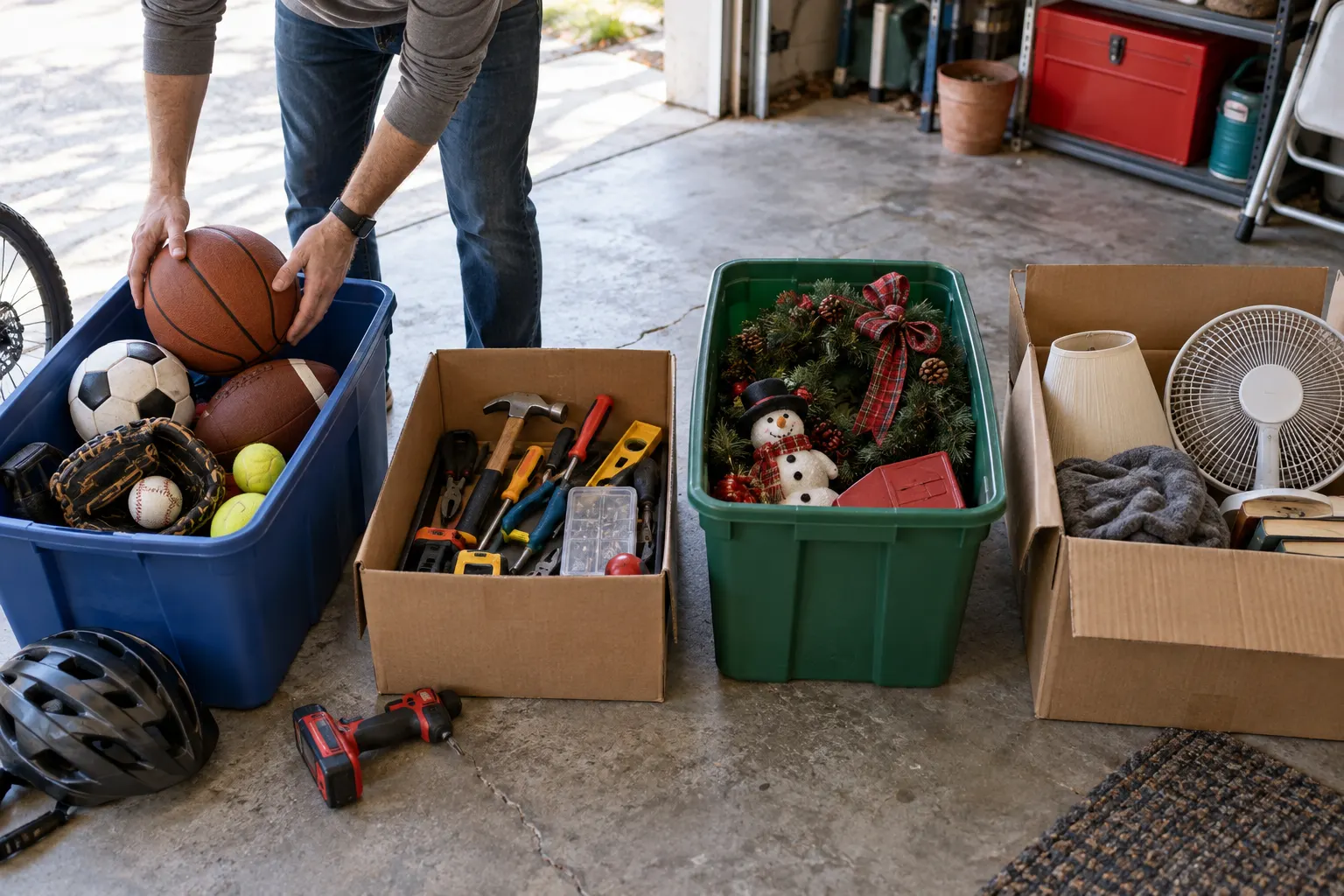
The fastest workable garage cleanout starts by clearing one safe walking lane from the garage door to the back wall. Then give every item one of four destinations: keep, donate, ordinary removal, or special handling. Do not start by pulling everything into the driveway. That creates weather risk, blocks vehicles, and forces you to sort the same pile twice.
Set up four zones before opening old boxes
| Zone | Put here | Rule |
|---|---|---|
| Keep | Tools, seasonal items, sports gear, and supplies you still use | Give each item a shelf, cabinet, or bin destination before it returns. |
| Possible donation | Clean, complete, working items in usable condition | Confirm acceptance before loading your vehicle. |
| Ordinary removal | Broken household goods, worn furniture, empty boxes, and accepted clutter | Keep personal records and special-handling items out. |
| Special handling | Chemicals, rechargeable batteries, fluorescent bulbs, unknown liquids, and refrigerant appliances | Do not mix these into the ordinary pile. |
Use physical distance instead of clever labels. A keep pile against one wall and a removal pile at the opposite corner is easier to understand than four nearly identical boxes.
Work in a sequence that preserves the exit
- Open the lane. Move only enough small material to create a clear path. Do not lift an awkward object over another pile.
- Remove obvious trash and empty packaging. Flatten clean cardboard separately. Lee County says extra cardboard may be flattened and placed beside the recycling cart.
- Handle one shelf or wall section at a time. Finish the decisions in that area before moving on.
- Leave heavy pieces in place. Photograph and measure them. Moving a refrigerator or sleeper sofa twice wastes effort and adds risk.
- Finish with the keep zone. Return only items that have a real storage destination.
A clean floor is not the same as an organized garage. The cleanout works when the items that remain have a place to live.
Stop when an item changes the disposal route
Lee County directs residents to its Topaz Court facility for many household chemicals, including cleaners, antifreeze, fluorescent bulbs, and rechargeable nickel-cadmium or lithium-ion batteries. The county also says rechargeable batteries should not go in the recycling cart. Keep these items closed and separate while you confirm the current drop-off rules.
Local source: Lee County Solid Waste, How Do I Dispose of Household Chemicals? and Battery Disposal, applicable to Lee County residents; retrieved September 17, 2026.
Pause on unlabeled liquids, swollen batteries, asbestos-containing material, medical sharps, ammunition, propane cylinders, or anything leaking. Do not open a container to identify it by smell. Ask the responsible facility or a qualified provider what to do.
Use this removal-day access checklist
- The keep zone is physically separate and easy to recognize.
- Keys, documents, medication, cash, photos, and jewelry are inside the home.
- Vehicles are out of the driveway and pets are secured.
- Gates are unlocked and the crew has building or elevator instructions.
- Sharp edges, broken glass, and unstable stacks have been identified.
- Chemicals, batteries, and unknown containers are not in the ordinary pile.
- The person approving removal can answer questions during the walk-through.
Choose DIY or a crew by the hard part of the job
DIY makes sense when the volume is small, the items are light, you have the right vehicle, and the local disposal route is clear. Professional help becomes more useful when the job includes bulky pieces, stairs, a long carry, several disposal categories, a deadline, or more volume than your vehicle can safely handle.
NIOSH’s lifting guidance evaluates weight together with hand position, travel distance, twisting, frequency, and grip quality. A number on a bathroom scale does not tell you whether a lift is safe in a crowded garage. Use equipment or help for heavy or awkward objects and keep the travel path clear.
Safety source: CDC/NIOSH, Revised NIOSH Lifting Equation, United States; retrieved September 17, 2026.
For inside carrying and loading, review the garage cleanout service. If furniture is the main obstacle, compare donation, county curbside pickup, and full-service hauling before choosing.
Need the carrying and loading handled?
Call or text 941-876-8609 with the item list, service address, and access details. Confirm accepted items and current availability before setting anything out.
Call 941-876-8609